What Happens If A Person Dies Without A Will?
Wills| 20.08.2026
If you have lost a family member who left no will, their estate in England and Wales will be shared out under the rules of intestacy in section 46 of the Administration of Estates Act 1925, not according to what anyone at the funeral remembers them saying. If you are married or in a civil partnership and there are no children, you inherit everything. If there are children, you take the personal chattels, a statutory legacy of £322,000 (provided the death occurred on or after on or after 26 July 2023) and half of what is left, with the other half going to the children. An unmarried partner, however long the relationship, inherits nothing under these rules and can only claim through the Inheritance (Provision for Family and Dependants) Act 1975, within six months of the grant.
Key Points
- You inherit under a fixed statutory formula in section 46 of the Administration of Estates Act 1925, and that formula overrides any informal wishes the person had expressed.
- If you are a surviving spouse or civil partner with children, you take the personal chattels, the first £322,000 (provided the death occurred on or after on or after 26 July 2023) of the estate and half the remainder; the other half is held on statutory trusts for the children.
- If you are an unmarried partner, a step-child who has not been legally adopted, or a close friend, the intestacy rules give you nothing, no matter how long you lived with the person who has died.
- A claim for reasonable financial provision under the Inheritance (Provision for Family and Dependants) Act 1975 must be issued in court within six months of the grant of representation, so early advice matters.
- Who applies to the Probate Registry, who has priority to be the administrator, and how the estate is valued for inheritance tax are separate practical steps that follow directly from the intestacy hierarchy.

On 15th March 2017 the Supreme Court handed down judgment in Ilott v The Blue Cross and others [2017] UKSC 17 and put a full stop on a ten-year dispute between Melita Jackson's estranged daughter and the three animal charities Mrs Jackson had chosen to inherit instead of her. The court unanimously restored District Judge Million's original award of £50,000 to Heather Ilott and set aside the Court of Appeal's award of £143,000, plus an option to draw down up to a further £20,000. Lord Hughes, giving the main judgment for a seven-Justice court, reaffirmed that in England and Wales a person is free to leave their estate to whomever they wish, and that a will, once validly made, is a serious instrument the courts will protect.
The point cuts the other way too. Where a person dies without a will, that same freedom disappears. Legislation provides who inherits, in what shares, and in what order, and no amount of family knowledge about what your relative “would have wanted” can change the outcome. If you have just lost someone who left no will, the first thing to understand is that your family is now inside a statutory formula, and your job is to work out where you sit within it and what you can do next.
Who inherits when there is no will?
If you die intestate in England and Wales, section 46 of the Administration of Estates Act 1925 sets a fixed order of beneficiary priority:
- Spouse or civil partner
- Children
- Parents
- Whole-blood siblings
- Half-blood siblings
- Grandparents
- Whole-blood aunts and uncles
- Half-blood aunts and uncles
- The Crown

The estate passes to the first class in which a relative survives. Nothing in the list can be varied by promises, letters, or family agreement. This is why it is crucial to ensure you have a valid will in place which is updated regularly as your personal and family circumstances change.
The order of entitlement set out in section 46(1) of the Administration of Estates Act 1925, and the same order is used by the Government Legal Department when it advertises unclaimed estates on the Bona Vacantia unclaimed estates list. Two features of the list are worth understanding before you look at your own family. A “spouse” for intestacy purposes means a legal spouse or civil partner on the date of death: separation does not remove the entitlement, but a decree absolute or final order of divorce does. A relative in a lower class inherits only if no one in a higher class survives the deceased by more than 28 days, under section 46(2A) of the Act.
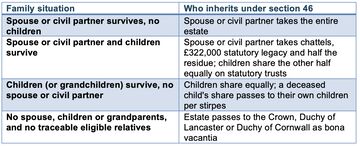
The table below sets out who inherits in the four situations we see most often.
What if I was not married to the deceased who died without a will?
You inherit nothing under the intestacy rules if you were not married to the person who has died or in a civil partnership with them, regardless of how long you lived together, whether you had children together, or whose name is on the mortgage. Your route to a share of the estate is a claim under the Inheritance (Provision for Family and Dependants) Act 1975, and the clock on that claim starts running from the grant of representation.
Section 1(1A) of the 1975 Act treats you as an eligible applicant if you lived in the same household as the deceased “as the husband or wife of the deceased” for the two years ending with the death. Section 1(1)(e) also lets you apply if you were being maintained by the deceased immediately before death, whether or not you lived together. In either case, the court's job is to decide what “reasonable financial provision” means for you on the facts, drawing on the factors in section 3 of the Act, including your resources and needs, the size and nature of the estate, and any obligations the deceased had towards you or the beneficiaries. A successful claim can produce a lump sum, periodical payments, a transfer of property or a settlement of property on trust.
Property owned as beneficial joint tenants sits outside the intestacy formula. If your name is on the deeds as a beneficial joint tenant, your share of the home passes to you automatically by survivorship on death, and the intestacy rules do not touch it. A tenancy in common is different: your partner's share falls into their estate and is distributed under section 46 of the Administration of Estates Act 1925, so a home held as tenants in common in equal shares can leave you owning half of a house with your late partner's parents, siblings, or adult children as your co-owners. If you are not sure how the property is held, our Solihull probate team can check the Land Registry entries before you decide what to do next.
How much does the spouse actually get?
If you are the surviving spouse or civil partner and there are children, you take the deceased's personal chattels, a fixed statutory legacy of £322,000 and half of everything that is left. The other half is held on statutory trusts for the children under section 46(1)(i) of the Administration of Estates Act 1925. If there are no children, you take the whole estate.
The £322,000 figure was set by the Administration of Estates Act 1925 (Fixed Net Sum) Order 2023, which came into force on 26th July 2023 and raised the previous statutory legacy of £270,000. The Order applies to deaths on or after that date. For deaths between 6th February 2020 and 25th July 2023, the £270,000 figure still applies, so a spouse whose partner died in that window may be working with a smaller statutory legacy than the current figure suggests. Interest runs on the statutory legacy from the date of death at the rate set out in section 46(1A) of the Administration of Estates Act 1925 until it is paid, so if the administration takes time the sum you receive is not eroded by delay.
The half of the residue held for the children is held on the “statutory trusts” defined in section 47 of the Administration of Estates Act 1925. In practice that means each child's share vests absolutely at 18 (or on earlier marriage or civil partnership). If a child of the deceased has already died leaving children of their own, those grandchildren inherit their parent's share in equal shares between them. Adopted children of the deceased inherit as if they had been born to the deceased; step-children who have not been legally adopted do not inherit under the intestacy rules at all.
A worked example makes the split easier to picture. If your husband died in October 2025 leaving an estate of £600,000 and two adult children from a previous marriage, you take his personal chattels, the £322,000 statutory legacy and £139,000 (half of the £278,000 residue). His two children share the other £139,000 equally, £69,500 each. The home may not be part of that maths at all if it was owned as beneficial joint tenants: it will already have passed to you by survivorship, outside the estate.
Do the children inherit everything under the intestacy rules of England and Wales?
If your parent died without a will and without a surviving spouse or civil partner, you and your siblings inherit the whole estate equally on the statutory trusts in section 47 of the Administration of Estates Act 1925. Adopted children are treated as children of the deceased; step-children who were not adopted are not.
Section 47 fixes the age of vesting at 18 for children born to or adopted by the deceased. If a child is under 18 when the parent dies, their share is held on trust until they reach 18 (or marry or enter a civil partnership before then), and the administrators of the estate are the trustees in the meantime. The Act treats a child conceived before but born after the death as living at the date of the death for these purposes.
Per stirpes distribution is the point that most often surprises families. If one of your siblings died before your parent, their share does not simply go back into the pot for the surviving children to share. It passes down to that sibling's own children in equal shares. So, if your mother left three children and one of them, your brother, had already died leaving two children of his own, your mother's estate is divided into three, not two: one third to you, one third to your surviving sister, and one third split equally between your brother's two children.
Grandchildren only inherit in place of a deceased parent. If all your parent's children are alive at the date of death, the grandchildren take nothing under section 46, even if the deceased was closer to a grandchild than to their own son or daughter. If that is not what your family expected, a will was the only tool that could have changed the position and putting that in place is one of the things our Solihull wills and probate solicitors can help you do while planning ahead for your own family.
What happens if there are no relatives?
If a person dies intestate in England and Wales and no relative in any of the categories listed in section 46 of the Administration of Estates Act 1925 survives them, the estate passes to the Crown, the Duchy of Lancaster or the Duchy of Cornwall as bona vacantia. In practice the Bona Vacantia Division of the Government Legal Department in Croydon administers unclaimed estates in England and Wales outside the two Duchies.
The Government Legal Department's guidance on claiming an unclaimed estate sets out how the Division works. Estates referred to the Division are advertised on the unclaimed estates list so entitled blood relatives have a chance to come forward. Claims are generally accepted within 12 years of the completion of the administration, with interest paid on money held during that period, and fully documented claims must be submitted within 30 years of the date of death. To claim, you send a family tree with birth, marriage and death certificates showing exactly how you are related to the deceased.
Ownerless estates are not the same as an estate with distant relatives. If a first cousin or a half-aunt survives, they inherit under section 46, however remote you might think that connection is. The Crown only takes where the search for eligible relatives is genuinely exhausted.
To successfully make a claim, your paperwork must prove not only your relationship to the deceased, but that no relative in a higher class survives. And a professional genealogist's fee, or an heir-hunter's percentage, is not payable by the Division: any share you agree to give them comes out of what you inherit.
Can I still challenge the outcome?
Yes. If the intestacy rules leave you without reasonable financial provision from an estate on which you were dependent, or with which you had a close family relationship, you can apply to the court under section 2 of the Inheritance (Provision for Family and Dependants) Act 1975 for an order varying the distribution.
Section 1 of the 1975 Act lists the people who can apply, namely:
- Spouses and civil partners
- Former spouses and civil partners who have not remarried or formed a new civil partnership,
- Children of the deceased
- Children of the family in a marriage or civil partnership of the deceased
- Cohabitants of two years or more
- Any other person maintained by the deceased immediately before death
Section 3 sets the factors the court weighs, including your resources and needs, the size and nature of the estate, any physical or mental disability, and the obligations the deceased had towards you or the beneficiaries. Section 4 imposes a hard time limit: your claim must be issued within six months of the grant of representation, unless the court gives permission to proceed out of time.
The Supreme Court decision in Ilott v The Blue Cross and others [2017] UKSC 17 is the leading authority on how the 1975 Act works for adult children who are not financially dependent on the deceased. The Supreme Court reinstated the original award of £50,000 made by District Judge Million, overturning the Court of Appeal's higher award. Lord Hughes emphasised that "maintenance" under the 1975 Act is not limited to subsistence levels but must be judged by the standard appropriate to the applicant's circumstances. He clarified that the need for maintenance is a necessary but not sufficient condition for an order, and the court must also consider other factors, such as the deceased's testamentary freedom and the specific circumstances of the case.,
Lord Hughes also warned against treating claims by adult children as an opportunity to rewrite the will based on the court's view of fairness. He highlighted that the 1975 Act does not require a moral claim as a prerequisite for all applications but noted that in cases involving adult children capable of living independently, "something more" than the qualifying relationship is often needed to justify a claim. This "something more" could include a moral claim or other relevant factors. For you, that means a 1975 Act claim is not a right to a share of the estate; it is a right to ask the court to consider whether the statutory formula, or the will, has failed to provide reasonably for your maintenance, and what a reasonable figure would look like on the facts.
How do I administer the estate if there is no will?
Where there is no will, the person entitled to apply for a grant of letters of administration is the person or persons highest in the order of priority set out in rule 22 of the Non-Contentious Probate Rules 1987:
- Surviving spouse or civil partner
- Children
- Parents
- Siblings (whole blood)
- Siblings (half blood)
- Grandparents
- Uncles and aunts (whole blood)
- Uncles and aunts (half blood)
Treasury Solicitor shall be entitled to a grant if he claims bona vacantia on behalf of the Crown if there is no one to claim a beneficiary interest.
You can act with up to three other administrators, and, where there is a beneficiary under 18, two administrators are needed so that a valid receipt can be given for the minor's share.
The steps you will need to take are broadly the same as for a testate estate, but with the intestacy hierarchy in place of the executor's authority. You will need to value the estate as at the date of death, deal with inheritance tax through HMRC, apply for the grant of letters of administration at the Probate Registry, collect in the assets, pay the debts, distribute according to section 46, and prepare estate accounts for the beneficiaries. Where the intestacy formula produces a difficult outcome for the family, the beneficiaries who are of full age and sound mind can agree a deed of variation within two years of the date of death under section 142 of the Inheritance Tax Act 1984 to redirect their entitlements, which can be a way to bring an unmarried partner or a step-child into the distribution where everyone agrees.
If you'd rather have control over who inherits your estate, our solicitors can guide you through making or amending a will so that your wishes are legally protected.
Click here for more information on whether your ex-spouse can inherit from you after divorce.
Click here for more information on the law of intestacy explained.
Frequently asked questions
What if we were separated but not divorced?
If you were legally separated from your spouse but not divorced, you are still their spouse for the purposes of section 46 of the Administration of Estates Act 1925 and you inherit under the intestacy rules on their death. A judicial separation removes some of the entitlement in specific cases, but only a final order of divorce breaks the intestacy link. That is one of the sharpest reasons to make a will as soon as a separation begins.
Do I need a solicitor to apply for letters of administration?
No, you are not required to instruct a solicitor to apply for a grant of letters of administration, and where the estate is small and straightforward you may prefer to apply yourself through the Probate Registry. Where the estate includes property, business assets, foreign assets, disputes between beneficiaries, or where inheritance tax is payable, most families we help find that having us handle the administration is quicker and reduces the risk of personal liability for mistakes.
Can we sort it out between us and ignore the rules?
You cannot override section 46 of the Administration of Estates Act 1925 by informal agreement, but the adult beneficiaries can enter a deed of variation within two years of the death under section 142 of the Inheritance Tax Act 1984 to redirect their entitlements to someone the intestacy rules leave out. Every beneficiary whose share is affected must agree, and minor beneficiaries generally require an application to the court.
How long do I have to bring an Inheritance Act claim?
You have six months from the grant of representation to issue a claim under the Inheritance (Provision for Family and Dependants) Act 1975. Section 4 of the Act gives the court discretion to allow an application out of time, but the discretion is limited and applying inside the six months is far safer. If you have received a grant or expect one to issue soon, get advice on your position quickly.
What if we find a will after we have started applying as if there was none?
Stop the application and get advice at once. The existence of a valid will overrides the intestacy rules and can change who the personal representative should be, who benefits from the estate, and what tax the estate must pay. If letters of administration have already been granted and a will is later found, the grant can be revoked so that a grant of probate can be applied for under the will instead.
Talk to Pearcelegal
If you have lost a family member who left no will, or if what you have just read has made you decide that your own family needs a will in place, we can help. We can walk you through where you sit in the section 46 hierarchy, look at a joint tenancy or tenancy in common with you, work out whether an Inheritance Act 1975 claim is worth pursuing, and take on the administration of the estate on your behalf. To speak to our private client team in Solihull, please contact Pearcelegal or call us on 0121 270 2700.
Author Bio: Jodie Hall
Jodie Hall is a Solicitor in the Private Client team at Pearcelegal, based in Solihull, West Midlands. She is regulated by the Solicitors Regulation Authority under SRA number 666606.
Jodie joined Pearcelegal in the summer of 2023, having qualified as a solicitor at a firm in London earlier that year. At Pearcelegal, she advises clients on Wills, Lasting Powers of Attorney, Probate and estate administration, and Trust matters. She has also contributed to the firm's legal content, including guidance on the probate process and considerations for making a will.
Client reviews rate Jodie 5.0 out of 5 across six reviews on Review Solicitors, Outside of work, Jodie enjoys experiencing new cuisines, cooking, and visiting National Trust sites.
Pearcelegal itself is authorised and regulated by the SRA under firm number 423097.
Last reviewed: August 2026

Expert advice for you Book a free consultation
The team at Pearcelegal will be delighted to discuss your legal matters and give you a no-obligation quote.