Evidence To Contest A Will
Wills| 28.09.2026
To contest a will, you need strong evidence that shows why it is invalid. In England and Wales, evidence includes the original will, earlier wills, codicils, the will writer’s file, medical records, witness accounts, messages and expert analysis. Your evidence must address the deceased’s position when the will was prepared or signed.
Key Points
- When challenging a will, the available evidence must show why the court may need to reconsider whether probate should be granted or continued.
- Start by gathering the original will, any earlier wills, the will writer’s file, and relevant medical notes and messages or emails from around the time the will was signed.
- A sense that “something is not right” is understandable, but the court needs clear details about the specific concern. Any claim must set out what is being alleged and the facts relied upon, rather than making a broad accusation.
- It is usually best to start looking into concerns as soon as possible. Over time, people’s memories can become less clear, messages may be lost, and the estate may be distributed before the issues have been properly explored.

Do you have grounds for contesting a Will?
If you are dealing with a will, perhaps from a deceased family member, that differs from what you believed the person wanted, you should gather suitable evidence if you wish to contest it. After someone has died, it can be difficult to piece things together. The person who made the will can no longer explain their decisions, and accounts from those around them may not always match. The most helpful next step is to separate understandable concerns from what the available documents and witnesses can show. This guide explains the evidence that may support each ground for contesting a will, where that evidence may be found and how to preserve it while the estate is being dealt with.
For more information on whether you can contest a will and the grounds on which you can do so, click here.
Gathering the key documents to contest the will
Before deciding whether there may be grounds to challenge a will, try to collect the most relevant documents.
Start with:
- The original will and any codicils (documents that change or add to a will)
- Any earlier wills
- The will writer’s file
- Relevant medical records
- Emails, text messages, letters or other communications from around the time the will was made
The original will can show how it was signed, whether it includes any changes or alterations, and whether it includes the usual wording confirming it was properly witnessed. Earlier wills can help show what changed over time. This does not prove that a later will is invalid, but it may help explain why questions have arisen.
The will writer’s file can be particularly useful. It may show what instructions were given, who arranged the appointment, who attended, whether the person was seen alone and whether the will writer carried out any checks about the person’s understanding.
What evidence supports each ground?
The evidence that may support the different grounds for challenging the will is set out below, including where evidence may fall short:
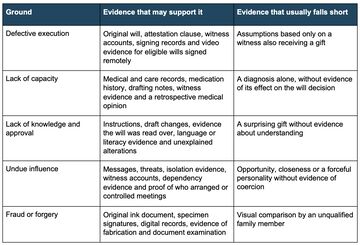
What evidence supports each ground?
Keep original documents safe
If a dispute is likely, keep the original will and other important documents safe and unchanged. Make copies to work from, but do not write on, staple, damage or alter the originals. If a court case begins, you may need to provide the court with any will or related document that you hold or control. You may also need to explain whether you know of any other wills and who has them. The court may need to inspect the original will, rather than a scanned copy. Original wills cannot simply be filed electronically.
Look at records from the right time
Medical evidence is usually most helpful when it relates to the period when the person gave instructions for the will or signed it. Relevant records may include information about:
- Memory problems or confusion
- Delusions or unusual beliefs
- Medication that may have affected understanding
- Difficulties communicating
- The person’s general health and independence
Financial records may also help show whether the person had a broad understanding of their assets and affairs. Emails, messages, letters, diary entries and call records may show what the person wanted, who was involved in arranging the will, or whether anyone may have put pressure on them. Where possible, keep full conversations rather than only selected screenshots. A single message can be misleading when it is taken out of context, and complete records are less likely to be challenged later.
Witness evidence to contest a will
In some cases it is necessary to seek the input of witnesses who saw or heard events relevant to the will, especially independent people present near the instruction or signing dates. The attesting witnesses can describe execution. The will writer can address instructions and understanding. A GP, carer, friend or neighbour may describe the deceased’s functioning, statements and exposure to pressure. First-hand recollection carries greater weight than family inference or repeated accounts.
In Hughes v Pritchard [2022] EWCA Civ 386, the Court of Appeal upheld a will despite a challenge to the deceased’s testamentary capacity. The court relied in part on evidence from the professional who prepared the will and the deceased’s GP. The case illustrates the importance of contemporaneous records: a detailed attendance note explaining the testator’s instructions and apparent understanding can be stronger evidence than a witness’s memory several years later.
In Rea v Rea [2024] EWCA Civ 169, the Court of Appeal rejected a claim that the deceased had been unduly influenced into making her will. It held that suspicious circumstances alone - such as reliance on a beneficiary, an opportunity to exert influence, or an uneven division of the estate - do not prove undue influence. There must be evidence that someone applied pressure which deprived the deceased of their own free choice.
If someone saw or heard something important, it is best to speak to them as soon as possible, while the details are still clear in their mind.
Ask each witness to give their own account in their own words. They should explain:
- What they personally saw, heard or did
- When it happened, or roughly when
- Who else was there
- How they remember the event
It is important that witnesses do not agree a shared version of events before giving their statements. Small differences between accounts are normal. But if several statements use exactly the same wording, it may make people question whether the accounts are truly independent.
Do I need an expert witness?
Sometimes an expert can help, especially where the concern is about:
- Whether the person had the mental capacity to make a will
- Whether a signature is genuine
- Whether a document has been changed
- Whether digital documents, emails or messages are authentic
An expert cannot fill in gaps where there is little or no factual evidence. Their opinion is only as useful as the information they are given.
For example:
- A medical expert assessing capacity will usually need relevant medical records and the notes made by the person who prepared the will.
- A handwriting expert will usually need the original will and genuine examples of the person’s signature.
- A digital expert may need the original electronic files and technical information showing when and how they were created.
The court will only allow expert evidence where it is genuinely needed to decide the case. You normally need the court’s permission before relying on an expert report, and the court will want to know what type of expert is needed, what questions they will answer and what the likely cost will be.
An initial opinion may sometimes help you decide whether your concerns are worth pursuing. However, it is usually sensible to obtain the key documents first. Paying for a full expert report before you have the will, the will writer’s notes or relevant medical records can be expensive and may not provide a clear answer.
A medical diagnosis alone does not decide whether someone had capacity to make a will. The expert must consider whether the person understood that they were making a will, had a broad understanding of their assets and appreciated the people who might reasonably expect to benefit. Experts must give an independent opinion to the court, even if you are the person paying for their report.
What should I do first if I want to contest a will?
Start by protecting the evidence and finding out where the estate administration has reached. You may need to:
- Keep the original will and other important documents safe. Do not mark, alter or damage them.
- Check whether probate has already been granted, or whether an application is underway.
- Identify the specific reason you believe the will may be invalid.
- Request the records that could support or rule out your concern.
- Write a simple timeline of important events, including when the will was made, who was involved and what documents support each point.
If probate has not yet been granted, you may be able to enter a caveat. A caveat can prevent a grant from being issued for a limited period while a genuine dispute is investigated. It is not appropriate simply because someone is unhappy with the will or has received less than expected.
The parties should usually share enough information to understand each other’s position, explore whether the dispute can be resolved and consider alternatives to court proceedings. A clear, focused letter is often more helpful than asking for every document connected with the family.
The letter should normally identify:
- The will you are concerned about
- Your connection to the estate
- The reason for your concern
- The documents or information you are asking to see
Once those records arrive, review the concern again. A late change to a will may have a straightforward explanation. For example, the will writer’s notes may show that the person gave clear instructions privately, repeated their wishes and had their capacity assessed at the time. On the other hand, those records may show that a beneficiary controlled all contact and gave the instructions on the person’s behalf.
If the dispute cannot be resolved, a court claim may be necessary. It is important to obtain legal advice before alleging fraud or undue influence. These are serious claims and, if they are not properly supported, can lead to unnecessary cost and distract from stronger concerns.
Final words
Contesting a will is not simply about whether the outcome feels unfair or unexpected. To take matters further, you will need evidence that points to a recognised legal problem with the will. The most useful first step is usually to preserve the original will and gather the key records. This may include earlier wills, the will writer’s notes, relevant medical records, and messages and information from people who knew the person when the will was made.
Act carefully and without delay. Some concerns may have a clear explanation once the records are available. Others may show that further investigation is needed. Taking the time to understand the evidence before making serious allegations can help you focus on the strongest issues and avoid unnecessary cost or conflict.
If you are worried about a will, early legal advice can help you understand what evidence is available, whether you have grounds to challenge it, and what practical steps to take next.
Frequently asked questions
Can I contest an unfair will?
An unfair outcome alone does not invalidate a will in England and Wales. You need evidence supporting defective execution, incapacity, lack of knowledge and approval, undue influence, fraud or forgery. A separate claim for reasonable financial provision may exist for an eligible applicant, with different evidence and a six-month statutory time limit from the grant.
Can medical records prove incapacity?
Medical records can support an incapacity challenge, especially where entries close to the will date record confusion, delusions or impaired understanding. A diagnosis does not decide testamentary capacity. The court also examines the will instructions, drafting evidence, the complexity of the estate and accounts from people who observed the deceased at the relevant time.
Is suspicion enough for undue influence?
No, suspicion alone cannot prove testamentary undue influence. Evidence must support coercion that overbore the deceased’s own decision. Useful material may include threats, controlling communications, isolation, witness accounts and evidence that the alleged influencer dictated instructions. Opportunity, dependency or a large benefit can prompt investigation, yet each remains compatible with a freely chosen gift.
If you want an assessment of the evidence behind a disputed will, contact Pearcelegal. We can review the documents, identify the factual gaps and give you a staged view of the available options before costs increase.
Further Reading:
Find out more about the likely costs of contesting a will, including the factors that can affect your legal fees.
Read about the recognised grounds for contesting a will and when a challenge may be possible.
For a broader overview of the process, read our complete guide to contesting a will.
About the Author
Sadia Ahmad - SRA number 802853.
Last reviewed: September 2026

Expert advice for you Book a free consultation
The team at Pearcelegal will be delighted to discuss your legal matters and give you a no-obligation quote.