What Are The Grounds For Contesting A Will?
Wills| 28.09.2026
To contest a will in England and Wales you need evidence of a recognised reason such as improper signing or witnessing, lack of mental capacity, lack of knowledge and approval, undue influence, fraud, forgery or revocation. The rules described here apply to wills governed by the law of England and Wales. Receiving less than expected, or disagreeing with the deceased’s decision, does not establish a validity challenge. A separate claim may arise if the will fails to make reasonable financial provision for you.
Key Points
- You can't contest a will just because you're disappointed with what you receive in your inheritance.
- To contest the will, you need evidence of incorrect execution, incapacity, lack of knowledge and approval, coercion, fraud, forgery, or revocation.
- Your options may include challenging validity, seeking rectification, claiming reasonable financial provision or negotiating an agreed variation of the estate.
- If you wish to contest a will, you need to do so within six months of the grant of probate
- Entering a caveat at the probate registry can prevent a grant for six months while a genuine dispute about the will or entitlement to administer the estate is investigated.

Do you have grounds for contesting a Will?
Something about a will may not feel right. Perhaps you don't recognise the signature, the person who died had serious memory or cognitive difficulties, someone close to them controlled who they could see, or the will is very different from earlier wishes with no clear explanation. Meanwhile, the estate may already be progressing towards distribution. Family relationships can make these concerns especially difficult. However, a court will focus on the available evidence: the will itself, medical and other records, witness accounts, and the circumstances in which it was prepared and signed. It is important to look at the facts carefully before making allegations, particularly as delays and disputes can increase estate costs.This guide explains when there may be grounds to challenge a will, the evidence you may need, the relevant time limits, and the possible outcomes.
Do I have legal grounds?
You may have legal grounds to challenge a will if:
- The will was not signed properly: A will must meet certain legal signing requirements, including being signed or acknowledged by the person making it in the presence of two witnesses. If the process was not followed, the will may be invalid.
- The person lacked mental capacity: The person making the will must have understood that they were making a will, what property they had, and who might reasonably expect to benefit from their estate.
- They did not understand or approve the will: Even where the person had mental capacity, there may be concerns that they did not fully understand what the will said or its effect—for example, because they were seriously unwell, vulnerable, unable to read it, or someone else took control of the arrangements.
- They were pressured into making it: A will can be challenged where another person used coercion or undue influence so that the person made a will they did not freely want to make. Being persuasive or involved is not enough; the pressure must have overridden the person’s own wishes.
- The will or signature was forged: A will may be invalid if the signature was not genuine, someone impersonated the person making it, or deception was used to obtain the will.
- There was a drafting mistake: If the will writer made a clerical error or failed to record the person’s instructions correctly, it may be possible to ask the court to correct the will so it reflects their true wishes.
A court does not set aside a valid will because its terms seem harsh. Testamentary freedom generally allows a person to favour one relative, exclude another or leave an estate to a friend or charity. The starting question is therefore what went wrong in law, supported by what evidence.
Which ground fits my concern?
When considering a challenge to a will, the courts will look at each type of ground differently as follows:
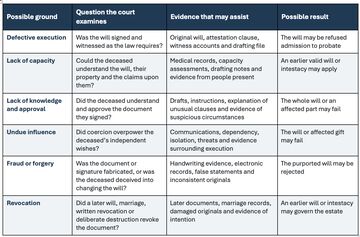
Which ground fits my concern?
Was the will signed correctly?
A will must comply with section 9 of the Wills Act 1837. The deceased must sign the document, or acknowledge an existing signature, in the presence of two witnesses who are present at the same time. Each witness must then sign or acknowledge their signature in the deceased’s presence.
Section 9 states: “No will shall be valid unless it is in writing, and signed by the testator, or by some other person in his presence and by his direction.” The section also requires an intention that the signature should give effect to the will. Evidence that only one witness attended, or that the witnesses signed later outside the deceased’s presence, may support a challenge.
Did the deceased have capacity?
The deceased needed to understand that they were making a will, the broad extent of their property, the people with possible claims upon them and the effect of the proposed gifts. A disorder affecting the mind can invalidate a will where the disorder influenced the dispositions made. A diagnosis of dementia does not, by itself, prove incapacity.
Capacity is assessed at the time the deceased gave instructions and executed the will. Medical records provide part of the evidence, alongside the will writer’s attendance notes, the complexity of the document, the deceased’s own explanation and accounts from people who saw them near the relevant date.
In Hughes v Pritchard EWCA Civ 386, the Court of Appeal set aside a finding of incapacity because the trial judge had not properly evaluated the evidence or adequately explained the rejection of expert opinion. A capacity case therefore requires a close review of all the available evidence instead of a conclusion based solely on age, illness or an unusual gift.
Did they understand the will?
An issue can arise where another person arranged the appointment, supplied instructions, translated the discussion, remained present throughout or received a substantial benefit under an unexpected new will.
In Gill v Woodall EWCA Civ 1430, the Court of Appeal held that the testatrix knew and approved the will, reversing the trial judge after evaluating the evidence as a whole. Suspicious circumstances require an explanation, although suspicion alone does not prove that the deceased misunderstood the document.
Evidence may show capacity while leaving knowledge and approval unresolved. A person can possess the mental ability to make a will and still sign a document whose contents were misrepresented or never properly explained.
What happens if a will is not valid?
If a will is found to be invalid, the estate does not simply pass to the people who would have benefited under that document. The next step depends on whether there is an earlier valid will, whether the problem affects the whole will or only part of it, and whether the parties can reach an agreement.
Possible ways of dealing with an invalid will include:
- Relying on an earlier valid will: If the most recent will is invalid, the previous valid will may take effect. For example, this may happen where a later will was not correctly signed, the person who made it lacked testamentary capacity, or it was made as a result of fraud or undue influence.
- Applying the intestacy rules: If there is no earlier valid will, the estate will usually pass under the intestacy rules. These rules set out who inherits when someone dies without a valid will, usually starting with a surviving spouse or civil partner and close blood relatives.
- Correcting a drafting error: If the will was validly made but contains a clerical or drafting mistake, the court may be able to rectify it so that it reflects the deceased’s true instructions. This may be appropriate where the will writer misunderstood or failed to record instructions correctly, rather than where the deceased later changed their mind.
- Setting aside only the affected gift or provision: In some cases, the problem may relate to a particular clause, gift or beneficiary rather than the entire will. The court may consider whether the affected provision can be separated from the rest of the will, allowing the remaining terms to stand.
- Reaching an agreement between those affected: Where the evidence is uncertain or the cost of litigation would be disproportionate, the beneficiaries and other interested parties may negotiate a settlement. This could involve an agreed division of the estate, a deed of variation, or a settlement recorded in a court order where proceedings have started.
- Making a claim for reasonable financial provision: A will can be valid but still fail to make reasonable financial provision for certain people, such as a spouse, civil partner, cohabitant, child or financial dependant. A claim under the Inheritance (Provision for Family and Dependants) Act 1975 is separate from a challenge to the validity of the will and can lead to provision being made from the estate.
Can a will be corrected rather than declared invalid?
Sometimes. If a will was validly signed and the deceased had capacity, but the wording does not reflect what they intended, it may be possible to ask the court to rectify the will.
Rectification is available where the will fails to carry out the deceased’s intentions because:
- There was a clerical error: For example, the will writer recorded the wrong amount, property, name or beneficiary by mistake.
- The will writer misunderstood the deceased’s instructions: For example, the deceased instructed that a particular property should pass to one person, but the will was drafted so that it passed to someone else.
The court can amend the will so that it gives effect to the deceased’s true instructions. This is different from a validity challenge, which argues that the will should not be admitted to probate at all.
Final words
Contesting a will is not simply a question of whether its terms feel unfair or disappointing. You will usually need evidence that there is a recognised legal problem with the will itself, such as an error in signing or witnessing, a lack of testamentary capacity, lack of knowledge and approval, undue influence, fraud, forgery, revocation or a drafting mistake.
The right course will depend on the facts. In some cases, the issue may be whether the will is valid at all. In others, it may be more appropriate to seek rectification, make a claim for reasonable financial provision, or explore an agreed settlement between those affected by the estate.
It is sensible to act promptly. Important evidence - including the original will, the will writer’s file, medical records and witness recollections - can be harder to obtain with time, and the options available may narrow once probate has been granted and the estate has been distributed. A caveat may provide time to investigate where there is a genuine dispute, but it should not be used without proper grounds.
Frequently asked questions
Can I contest a will because I was left out or received less than expected?
Not usually. A will is not invalid simply because its terms are unexpected, unequal or disappointing. To challenge its validity, you need evidence of a recognised legal ground, such as improper signing, lack of capacity, lack of knowledge and approval, undue influence, fraud, forgery or revocation. Depending on your relationship with the person who died, you may instead have a separate claim for reasonable financial provision from the estate.
How long do I have to contest a will?
The time limit depends on the type of claim. Some challenges to the validity of a will do not have the same strict short deadline as an Inheritance Act claim, but it is important to act as soon as possible. A claim for reasonable financial provision under the Inheritance (Provision for Family and Dependants) Act 1975 normally needs to be issued within six months of the grant of probate. Claims to correct a drafting error also generally have a six-month deadline from the grant. Prompt action helps preserve evidence and may prevent the estate being distributed.
Can I stop probate while I investigate a will?
You may be able to enter a caveat at the Probate Registry if you have a genuine dispute about the validity of a will or the right to take out a grant of probate. A caveat normally lasts for six months and can prevent a grant being issued while concerns are investigated. It is not appropriate simply to delay the administration of an estate, and it can be challenged by the person applying for probate.
What evidence is needed to challenge a will?
The evidence will depend on the reason for the challenge. It may include the original will, the will writer’s file and attendance notes, earlier wills, medical and care records, statements from witnesses, correspondence, financial documents and evidence about the deceased’s circumstances at the time the will was made. Where forgery is alleged, original signature samples and an expert handwriting opinion may also be relevant.
What happens if a will is found to be invalid?
If the latest will is invalid, an earlier valid will may take effect instead. If there is no earlier valid will, the estate will usually be administered under the intestacy rules. In some cases, the court may correct a drafting error rather than invalidate the whole will. The outcome will depend on the particular ground of challenge and the evidence available.
Further Reading:
Find out what evidence may be needed to contest a will, including medical records, solicitor files and witness evidence.
Read our guide to the costs involved in contesting a will and the factors that can affect the overall expense.
For a broader overview of the process, read our complete guide to contesting a will.
About the Author
Sadia Ahmad - SRA number 802853.
Last reviewed: September 2026

Expert advice for you Book a free consultation
The team at Pearcelegal will be delighted to discuss your legal matters and give you a no-obligation quote.