Complete Guide To Probate
Probate| 08.09.2026
If you have been named as an executor, or there is no will and you are the closest surviving relative, you will usually need a Grant of Probate or Letters of Administration in England and Wales before any bank, or the Land Registry will deal with you. The court application fee is £526 for any estate worth more than £5,000, following a fee rise on 13th July 2026, and most straightforward applications take around twelve weeks to be granted. Inheritance Tax, where it applies, must be paid within six months of the death, and a spouse, child or dependant left out of the estate has six months from the grant to bring a claim. If you have just registered a death, you have longer to act than the paperwork in front of you might suggest.
Key Points
- You need a Grant of Probate before a bank, share registrar or the Land Registry will release a sole-name asset to you, though jointly held property and joint accounts usually pass to the surviving owner without one.
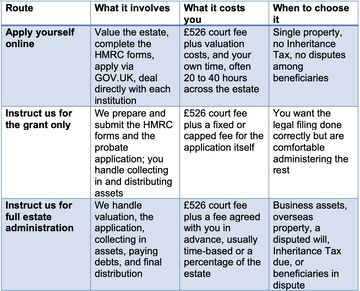
- Your main routes are applying yourself online for the £526 court fee alone, instructing us to prepare the application while you administer the rest, or asking us to handle the whole estate from valuation to final distribution.
- Inheritance Tax must be paid within six months of the month of death, and the nil-rate band of £325,000 per person, plus a £175,000 residence nil-rate band, is frozen until April 2028.
- Missing the six-month window after a grant is issued does not stop a spouse, child, cohabiting partner or dependant bringing an Inheritance (Provision for Family and Dependants) Act 1975 claim, so distributing the estate early can leave you personally liable if a claim later succeeds.
- Doing nothing leaves bank accounts frozen, a property unsellable, and Inheritance Tax interest accruing at 7.75% from six months after the death, whether or not you have applied for a grant.
What is probate?
Probate is the legal process of administering a deceased person's estate, ensuring their assets are distributed according to their Will or, in the absence of a valid Will, under the rules of intestacy. It involves obtaining a grant of representation, which is a document issued by the court that authorises the personal representative to manage the deceased's estate. If the deceased left a valid Will appointing an executor, the grant is called a grant of probate. If there is no Will or the Will is invalid, the grant is referred to as letters of administration
What should I do in the first few weeks after someone dies?
It can be extremely difficult to deal with the administration side of death when you are grieving. Registering the death is the most important first step, along with arranging the funeral. Fortunately, you can use the Government’s ‘Tell Us Once’ service to notify most departments of the death. Funeral organisers are also incredible people who can provide invaluable guidance and advice at this time.
Once the funeral is organised, you need to locate the deceased’s will and any codicils. It will name and executor and they will need to take things from there.
Where there is no will, the Administration of Estates Act 1925 sets out who inherits and who has the right to apply for Letters of Administration under the laws of intestacy.
Once you have the will, tell the main asset holders that the account holder has died, and ask each one for a valuation as at the date of death. Every institution sets its own process for this step, so a written notification with a copy of the death certificate is the safest way to start each conversation.
Do I need to apply for probate at all?
You need probate if the person who died held a property, bank account, or investment portfolio in their sole name above the individual institution's own small-estates limit, typically between £5,000 and £50,000. If everything passed to a surviving joint owner automatically, you may not need a grant.
Jointly held property and joint bank accounts usually pass to the surviving owner by survivorship, outside the estate and without a grant. A sole bank account, a sole share portfolio, or a house held in one name is different: the institution holding it will insist on seeing the grant before it releases anything. Each bank sets its own threshold, so check directly with the specific institution rather than assuming a fixed rule applies everywhere.
Who has the right to apply?
If there is a valid will, the executor named in it has the right to apply. If there is no will, the Administration of Estates Act 1925 sets a strict order of priority, starting with a surviving spouse or civil partner, then children, then more distant relatives.
Where a will names more than one executor, up to four can apply jointly, and any one of them can act alone unless the will says otherwise. Where there is no will, only the person highest in the statutory order under the 1925 Act can apply without consent, and anyone lower down needs written agreement from those above them, or proof that they have renounced their right.
What does a grant of probate actually let me do?
A grant is the court's written confirmation that you have the legal authority to collect in the deceased's assets, pay their debts, and distribute what remains. Without it, a bank, share registrar or the Land Registry is entitled to refuse to deal with you, whatever the will says.
Section 25 of the Administration of Estates Act 1925 confirms that once a grant has been made, nobody else has authority to act as executor over the estate it covers. For you, this means a bank that hands over funds without sight of the grant, where a grant was legally required, has acted at its own risk, which is why almost every institution insists on the original or an official copy before releasing anything of value.
How much will probate cost me?
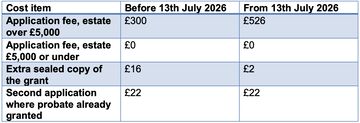
The court fee for a Grant of Probate or Letters of Administration is £526 for any estate worth more than £5,000, following the fee rise that took effect on 13th July 2026, with no fee at all below that threshold. Extra sealed copies of the grant now cost £2 each, down from £16 before the same date.
HM Courts & Tribunals Service confirmed that the probate application fee rose from £300 to £526 from 13th July 2026, while the fee for additional sealed copies fell from £16 to £2 per copy. If you need several copies to deal with multiple banks and the Land Registry at once, that copy-fee cut offsets part of the increase, though the core application fee is now considerably higher than it was for most of the first half of 2026.
Beyond the court fee, you may also pay for professional valuations of property and shares, our fees if you instruct us, and disbursements such as a Statutory Notice in The Gazette, which protects you personally against late-arriving claims from creditors you did not know about.
What is a fair way to compare doing it myself against instructing you?
You can apply for probate yourself for the £526 court fee alone where the estate is simple: a single property, an uncontested will, and no Inheritance Tax due. You are more likely to need us where the estate includes a business, overseas assets, a disputed will, or any Inheritance Tax liability.
We have supported executors and administrators across Solihull and the West Midlands with probate and estate administration for over 40 years, and the estates that take longest are almost always the ones where a sole account or an overseas asset was missed at the valuation stage.
When do I need to worry about inheritance tax?
You must establish whether Inheritance Tax is due before you can apply for probate, and if it is due, you must pay it, or arrange to pay it, before HMRC issues the code that lets your application proceed. The nil-rate band is £325,000 per person, frozen until April 2028, with a further £175,000 residence nil-rate band available where a main home passes to children or grandchildren.
As HM Revenue and Customs states in its guidance on paying an Inheritance Tax bill: "You must pay Inheritance Tax by the end of the sixth month after the person died." For you, that means if the death occurred in January, the tax is due by 31st July of that year, whether or not you have finished valuing every asset. Missing that date starts interest running on the unpaid balance, and HMRC's published rate stood at 7.75% from 9th January 2026, calculated as the Bank of England base rate plus 2.5 percentage points.
A married couple can typically shelter up to £1 million from Inheritance Tax between the standard nil-rate bands and the residence nil-rate bands of both spouses, because unused allowance transfers to the surviving spouse or civil partner on the first death. Where the estate includes a property that will take time to sell, you can apply to HMRC to pay the tax attributable to that property in instalments over ten years, with the first instalment still due at the normal six-month deadline.
What happens if there is no will?
If the person who died left no valid will, the Administration of Estates Act 1925 decides who inherits, in a fixed order that does not always match what they would have wanted, and a surviving unmarried partner has no automatic entitlement at all. A surviving spouse or civil partner receives the first £322,000 of the estate plus all personal possessions, and where there are children, half of anything above that figure, with the other half held for the children.
Where there is no surviving spouse and no children, the order moves to parents, then siblings, then more distant relatives, in the sequence the 1925 Act sets out. Cohabiting partners who were never married receive nothing automatically under intestacy, however long the relationship lasted, unless they bring a claim under the Inheritance (Provision for Family and Dependants) Act 1975.
If you are unsure where you stand under the intestacy rules, our Wills, trusts and probate team can check the order of entitlement against the specific family structure involved before you take any further step.
Can someone challenge the will or the intestacy outcome?
Yes, a spouse, former spouse, cohabiting partner, child or financial dependant of the person who died can apply to the court under the Inheritance (Provision for Family and Dependants) Act 1975 if the will, or the intestacy rules, fail to make reasonable financial provision for them. You have six months from the date the grant is issued to contest a will under the 1975 Act, so the clock starts running once probate or letters of administration are granted, not from the date of death.
How long does the whole process take?
Most straightforward applications result in a grant within twelve weeks of submission, though this can extend well beyond that where HMRC queries the Inheritance Tax return or the Probate Registry raises questions about the will. Once you have the grant, collecting in assets, settling debts and distributing the estate typically takes a further six to twelve months for an average estate.
Online applications are generally processed faster than postal ones and providing every document correctly at the first attempt avoids the most common cause of delay: the Registry writing back to request missing information. Two separate time limits then govern when you can safely distribute what remains. Section 27 of the Trustee Act 1925 lets you protect yourself from unknown creditors by placing a notice in The Gazette and waiting a minimum of two months from publication before distributing. Separately, the six-month window for an Inheritance Act 1975 claim runs from the date of the grant, so many executors wait until that six-month period has passed as well before making a final distribution.
What if I do nothing?
If you take no steps at all, the deceased's bank accounts stay frozen, the property cannot be sold or transferred, and Inheritance Tax interest continues to accrue from six months after the death whether or not you have applied for a grant. Beneficiaries cannot be paid, a surviving spouse may struggle to access joint household funds tied up in the deceased's sole accounts, and any mortgage or unpaid utility bills keep growing while nobody holds the legal authority to settle them.
Delay also narrows your own protection: the six-month window for an Inheritance Act 1975 claim only starts once a grant is issued, so an executor who never applies never starts that clock, leaving an estate exposed indefinitely to a future claim rather than closing it down.
Frequently asked questions
Do I need to instruct you to apply for probate?
No, you can apply for probate yourself for the £526 court fee if the estate is straightforward, with a single property, no Inheritance Tax to pay, and no disputes between beneficiaries. Instructing us reduces the risk of a rejected application or a later Inheritance Act claim where the estate includes overseas assets, a business, or a disputed will.
How long do I have to pay inheritance tax?
You have until the end of the sixth month after the month of death to pay any Inheritance Tax due, after which HMRC begins charging interest on the unpaid balance. If the estate includes property that has not yet sold, you can apply to pay the tax attributable to that property in instalments over ten years.
Can I access the deceased's bank account before probate is granted?
Usually not, if the account was held in the deceased's sole name and holds more than the individual bank's small-estates limit, typically between £5,000 and £50,000. Joint accounts held with a surviving partner usually pass automatically by survivorship and do not require a grant.
What happens if a beneficiary contests the will?
A beneficiary, spouse, former spouse, cohabiting partner, child or dependant can bring a claim under the Inheritance (Provision for Family and Dependants) Act 1975 within six months of the grant being issued. You should avoid distributing the estate until that six-month window has passed, since a successful claim can require you to return assets already paid out.
Do I still need probate if there is no property in the estate?
Yes, you may still need probate if the person who died held bank accounts, shares or investments above the relevant institution's own small-estates threshold, even without a property. Where every asset was jointly held or falls below each institution's own limit, you may be able to deal with the estate without applying for a grant at all.
Talk to Pearcelegal
If you are dealing with an estate and are not sure whether you need probate, what it will cost, or how long it will take, we can look at your situation and tell you where you stand before you spend anything. Contact Pearcelegal and we will talk you through the option that fits your circumstances.
Further Reading:
Learn more about Inheritance Tax, including when it may be payable and the options that may reduce a future bill.
Our article on estate administration explains the personal representative’s responsibilities when managing and distributing an estate.
You can also find out how long probate can take and why some estates take longer to finalise.
Author: Jodie Hall
Jodie Hall is a Solicitor in the Private Client team at Pearcelegal, based in Solihull, West Midlands. She is regulated by the Solicitors Regulation Authority under SRA number 666606.
Jodie joined Pearcelegal in the summer of 2023, having qualified as a solicitor at a firm in London earlier that year. At Pearcelegal, she advises clients on Wills, Lasting Powers of Attorney, Probate and estate administration, and Trust matters. She has also contributed to the firm's legal content, including guidance on the probate process and considerations for making a will.
Client reviews rate Jodie 5.0 out of 5 across six reviews on Review Solicitors, Outside of work, Jodie enjoys experiencing new cuisines, cooking, and visiting National Trust sites.
Pearcelegal itself is authorised and regulated under SRA firm number 423097.
Last reviewed: August 2026
Click here for more information on what happens if you die without a will.
Click here for more information on the law of intestacy explained.

Expert advice for you Book a free consultation
The team at Pearcelegal will be delighted to discuss your legal matters and give you a no-obligation quote.