How Long Does Probate Take?
Probate| 08.09.2026
You will usually wait about five weeks for a grant of probate if your application is complete and submitted online, but a stopped case took around 14 weeks on average in January to March 2026. This applies in England and Wales, where the Ministry of Justice recorded 65,254 probate grant applications and an average five week issue time in the first quarter of 2026. GOV.UK still advises allowing up to 12 weeks for the grant itself, while the full administration of an estate often runs for several more months after that. A missing document or an unresolved tax query is the main reason a short wait turns into a long one.
Key Points
- You are usually waiting on one of two tracks: a clean probate application that moves quickly, or a stopped file that sits in a slower queue until the missing point is resolved.
- You have three main routes: apply online yourself, ask us to handle the application only, or instruct us to manage the whole estate from valuation to final distribution.
- Five weeks is the Ministry of Justice's mean average time from application submission to probate grant issue for January to March 2026, while GOV.UK still tells applicants to allow up to 12 weeks.
- A stopped application averaged 14 weeks in the same quarter, and HMCTS moves it into a separate queue until you supply the information or document it has asked for.
- Leaving a stopped file unanswered keeps the estate frozen, delays access to funds and property and pushes every later step in the administration further back.
At the end of March 2026, 42,490 probate cases were still open with HM Courts & Tribunals Service. The Ministry of Justice's quarterly figures also show that 70% of probate grants issued in that period were digital applications that had not been stopped and were issued in about two weeks from submission. Although those figures suggest many estates move faster than they did a few years ago, your own timescale changes sharply if HMCTS stops the file for a will query, an Inheritance Tax issue, or a mismatch on the papers.
How long will I wait?
You will usually wait around five weeks for the grant, but a clean digital probate application can be issued in about two weeks, and a stopped case took around 14 weeks in early 2026. GOV.UK still advises allowing up to 12 weeks, which remains a sensible outer estimate for a straightforward application with no dispute attached.
The Ministry of Justice's Family Court Statistics for January to March 2026 draw a clear distinction between case types. Probate grants took approximately five weeks on average from application submission to issue. Letters of administration without a will took around 11 weeks, and letters of administration with a will annexed took around 20 weeks.
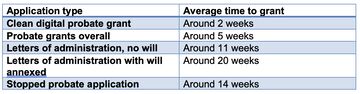
Average time to grant of probate
As GOV.UK states in its guidance on applying for probate: "You'll usually get the grant of probate or letters of administration within 12 weeks of submitting your application." For you, that means a file still sitting untouched beyond 12 weeks is outside the usual range and worth chasing.
What slows probate down?
Your application usually slows down because HMCTS has stopped it for an unanswered query, an Inheritance Tax issue, or a problem with the will or form. Once that happens, the file leaves the quick digital route and joins a separate queue that took around 14 weeks on average to process in January to March 2026.
The Ministry of Justice's figures explain the scale of the split. Seventy per cent of total probate grants issued in the quarter were digital probate grants that had not been stopped, and those took around two weeks from application submission to grant issue. A stopped probate application took 14 weeks on average. HMCTS explains in its probate service update that when an application is stopped, it is moved into a separate queue while the Registry waits for the information or documents it needs.
Three problems cause most avoidable delay. The first is a mismatch between the application and the death certificate, such as a misspelt name or the wrong date. The second is an Inheritance Tax issue, especially where HMRC is still waiting for the right return or figures. The third is a problem with the will itself, such as damage, uncertainty over a codicil, or a missing step in the signing process.
How long does estate administration take?
The grant is usually only the first timed stage, and the full estate administration often takes a further six to twelve months after the grant is issued. If the estate includes a house to sell, overseas assets, or tax complications, the overall timetable commonly extends to nine to eighteen months or longer.
You can collect some information before the grant arrives, but you cannot usually close accounts, sell a sole-name property, or distribute the estate until the grant has been issued and the debts have been dealt with. Where Inheritance Tax is due, HM Revenue and Customs says in its guidance on paying an Inheritance Tax bill: "You must pay Inheritance Tax by the end of the sixth month after the person died." For you, that means tax deadlines may bite long before the estate is ready to distribute.
If you are close to the point of distribution, section 27 of the Trustee Act 1925 allows you to place a notice for unknown creditors and wait at least two months from publication before distributing.
Can I speed it up?
You cannot force HMCTS to issue the grant faster, but you can avoid the delays that cause most long waits and respond quickly if the Registry stops your file. Applying online, checking every detail against the death certificate, and resolving the Inheritance Tax position early give you the best chance of staying on the quicker track.
You also have a choice about how much of the process to do yourself. A simple estate with a clear will and no Inheritance Tax issue is often manageable with an online application. A disputed will, an intestacy, or a taxable estate is more likely to slow down unless the paperwork is prepared carefully from the start.
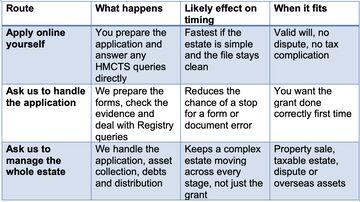
Probate options
We can help you with probate and estate administration if the file has already stalled or if you want to cut the risk of a stop before you apply.
When should I call you?
You should call us before you apply if the estate is taxable, there is no will, the will is damaged or disputed, or you are already beyond the 12-week guide time with no clear answer from HMCTS. Those are the points where a delay usually stops being administrative and starts affecting what you can safely do with the estate.
A short review of the papers can often identify the real cause of the hold-up. If the problem is a form issue, a missing document, or the way the tax position has been presented, we can usually tell you that straight away. If the problem is a dispute over the will or over who has the right to apply, we can tell you what your options are and what each one is likely to cost in time and risk.
You may also want advice sooner if a property sale depends on the grant, because a buyer's timetable rarely waits for a probate query to be resolved. Our Wills, trusts and probate team can look at the estate papers with you and tell you where the real delay is coming from.
Frequently asked questions
Can I chase HMCTS after 12 weeks?
Yes. GOV.UK says you will usually get the grant within 12 weeks of submitting the application, so a file that has gone beyond that point without progress is worth following up.
Does Inheritance Tax delay probate?
It can. Where a full Inheritance Tax return is needed, HMRC and HMCTS both need the tax position to be in order before the grant can be issued.
Why has my application been stopped?
A probate application is usually stopped because HMCTS needs more information, there is a problem with the will, or the details on the form do not match the supporting papers.
Talk to Pearcelegal
If you are waiting for a grant and do not know whether the delay is normal or avoidable, we can look at the papers and tell you where you stand. Contact Pearcelegal and we will talk you through the fastest realistic route for your estate.
Further Reading:
Read our guide to estate administration to understand the main tasks involved in dealing with a person’s assets, debts and liabilities after death.
For information on Inheritance Tax thresholds, exemptions and payment deadlines, see our dedicated article.
For a step-by-step overview, visit our complete guide to probate.
Author: Jodie Hall
Jodie Hall is a Solicitor in the Private Client team at Pearcelegal, based in Solihull, West Midlands. She is regulated by the Solicitors Regulation Authority under SRA number 666606.
Jodie joined Pearcelegal in the summer of 2023, having qualified as a solicitor at a firm in London earlier that year. At Pearcelegal, she advises clients on Wills, Lasting Powers of Attorney, Probate and estate administration, and Trust matters. She has also contributed to the firm's legal content, including guidance on the probate process and considerations for making a will.
Client reviews rate Jodie 5.0 out of 5 across six reviews on Review Solicitors, Outside of work, Jodie enjoys experiencing new cuisines, cooking, and visiting National Trust sites.
Pearcelegal itself is authorised and regulated under SRA firm number 423097.
Last reviewed: August 2026
Click here for more information on what happens if you die without a will.
Click here for more information on the law of intestacy explained.

Expert advice for you Book a free consultation
The team at Pearcelegal will be delighted to discuss your legal matters and give you a no-obligation quote.